Acronym
J1-70028
Department:
Department of Microbiology
Type of project
ARIS projects
Type of project
Basic research project
Role
Lead
Duration
01.03.2026 - 28.02.2029
Total
1,6 FTE
Project manager at BF
Grosboillot Virginie Marie-AlineResearch Organisation Partners
- Faculty of Computer and Information Science
- Faculty of Pharmacy
External Research Organisation Partners
- Institute for Molecular Bioscience, University of Queensland, Brisbane
Abstract
Bacteriophages, or phages, are the most abundant biological entities on Earth, with an estimated global population of 10³¹, significantly outnumbering bacteria. These viruses can adopt two primary life cycles: the lytic cycle, which leads to immediate replication and lysis of the host, and the lysogenic cycle, in which phage genomes integrate into the bacterial host chromosome as prophages. Remarkably, approximately 70% of bacterial genomes harbour prophages, which can constitute 10 to 20% of the bacterial genome in some instances. Their presence has profound implications for the phenotype of their bacterial hosts, influencing traits such as fitness, cell wall structure, and notably, antibiotic susceptibility. This latter aspect is particularly pertinent in the context of the escalating global crisis of antimicrobial resistance, where understanding the interplay between prophages and their bacterial host responses to antibiotics is critical for developing innovative therapeutic strategies. Despite the known capacity of prophages to modify bacterial cell walls, for instance to prevent superinfection, research into how these modifications can enhance antibiotic sensitivity is limited, with the underlying molecular mechanisms largely unexplored. Preliminary data obtained by our team indicate that specific prophages belonging to the SPbetavirus genus can reduce the minimum inhibitory concentration for cell wall-targeting antibiotics in Bacillus subtilis. Interestingly, these changes in antibiotic susceptibility can be coupled with notable morphological alterations to the host bacterial cells, without affecting its viability. We hypothesise that the prophages induce cell wall alterations, leading to an increased susceptibility of the bacterial host to cell wall-targeting antibiotics. In addition, the fact these modifications do not impact the viability of the host bacteria, suggests that this mechanism might be conserved in other phage-host relationships. The proposed research project seeks to investigate the cell wall modifications in B. subtilis induced by SPbetavirus prophages, specifically focusing on their role in increasing host susceptibility to cell wall-targeting antibiotics, such as ampicillin. The research aims to elucidate the structure and composition of the bacterial cell wall, identify the prophage genes/proteins responsible for these modifications, and determine whether these mechanisms are specific to B. subtilis or applicable to other bacterium-prophage systems. The project is organised in four work packages: 1) Characterisation of structural and compositional changes at the cell surface induced by prophage integration; 2) Investigating the molecular mechanisms underlying prophage mediated changes in cell wall composition; 3) Creating a knowledge graph on prophage-induced cell wall morphology and composition alterations related to changes in antibiotic susceptibility and; 4) Assessing the impact of candidate genes on efficacy of cell-wall-targeting antibiotics and on host morphology. This project aspires in advancing our understanding of how prophages interact with their hosts, particularly their cell surface and how these changes relate to an increase susceptibility in cell wall-targeting antibiotics. By bridging the gap in understanding how prophages can sensitise bacteria to antibiotics, this research has the potential to inform novel therapeutic strategies aimed at combating antibiotic resistance, ultimately contributing to the optimisation of antibiotic treatments in an era of increasing bacterial resistance.
External link to Researchers Open in new window
- External link to Virginie Grosboillot Open in new window
- External link to Valentina Floccari Open in new window
- External link to Anna Dragoš Open in new window
- External link to Nina Vesel Open in new window
- External link to Hannah Bonham Open in new window
- External link to Anja Klančnik Open in new window
- External link to Blaž Jug Open in new window
- External link to Tomaž Bratkovič Open in new window
- External link to Mojca Lunder Open in new window
- External link to Ana Mitrović Open in new window
- External link to Tomaž Curk Open in new window
- External link to Martin Špendl Open in new window
The phases of the project and their realization
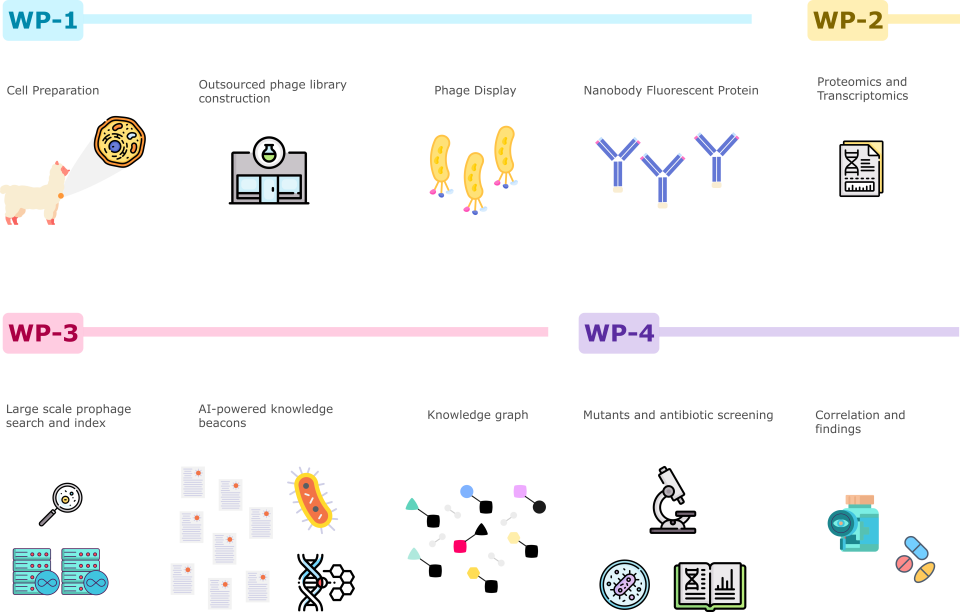
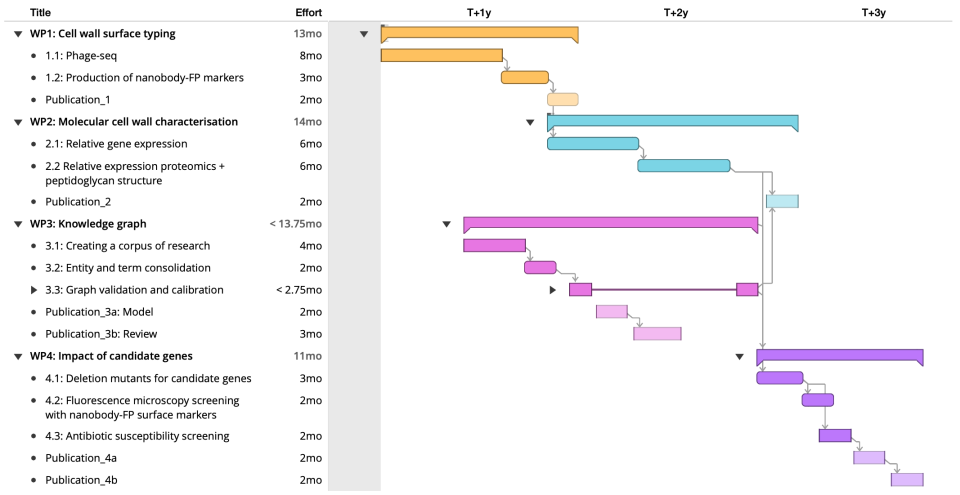
- WP1: Characterisation of structural and compositional changes at the cell surface induced by prophage integration
Milestone 1: Affinity profile for each lysogens completed + Fluorescent markers (Nanobody-FP) produced and tested
- WP2: Investigating the molecular mechanisms underlying prophage mediated changes in cell wall composition
Milestone 2: List of genes and proteins potentially involved in the compositional and structural changes occurring at the cell surface after prophage integration
- WP3: Creating a knowledge graph on prophage-induced cell wall morphology and composition alterations related to changes in antibiotic susceptibility
Milestone 3: Knowledge graph completed and available for consumption
- WP4: Assessing the impact of candidate genes on efficacy of cell-wall targeting antibiotics and on host morphology
Milestone 4: Deletion mutants tested, and mutation correlated with lysogens and antibiotic susceptibility